Last updated 2026-07-09
TL;DR
In most states a sheriff's deputy or constable can serve divorce papers, and in a few states they're the preferred method. Private process servers and certified mail are also valid in most places. City patrol officers generally cannot serve civil papers on duty. Costs run from free to about $75 per attempt. The rules change a lot by state.
What does it mean to 'serve' divorce papers?
Service of process is the formal delivery of legal documents that tells the other party a lawsuit has started. In a divorce, that means handing the summons and petition to your spouse. Until your spouse is properly served, the court can't move forward. A judge has no power over someone who hasn't received official notice.
This rule comes from the Due Process Clause of the Fourteenth Amendment, which guarantees that no one loses legal rights without notice and a chance to be heard [1]. Every state writes its own civil procedure rules that spell out who can serve, how they do it, and what proof they file afterward.
The person who delivers the papers is the process server. The document they sign afterward, proving delivery happened, is the proof of service or affidavit of service. Without that filed proof, your divorce can sit still for months. Courts see incomplete service constantly. It's one of the top reasons uncontested divorces drag on longer than they should.
Service is not the same as mailing your spouse a copy for reference. Informal notice does not satisfy the legal requirement. The court wants documented proof, not a courtesy heads-up.
Can a police officer legally serve divorce papers?
It depends on the state and which kind of officer you mean. Short version: a sheriff's deputy or constable, yes, in most states. A city patrol officer, almost never.
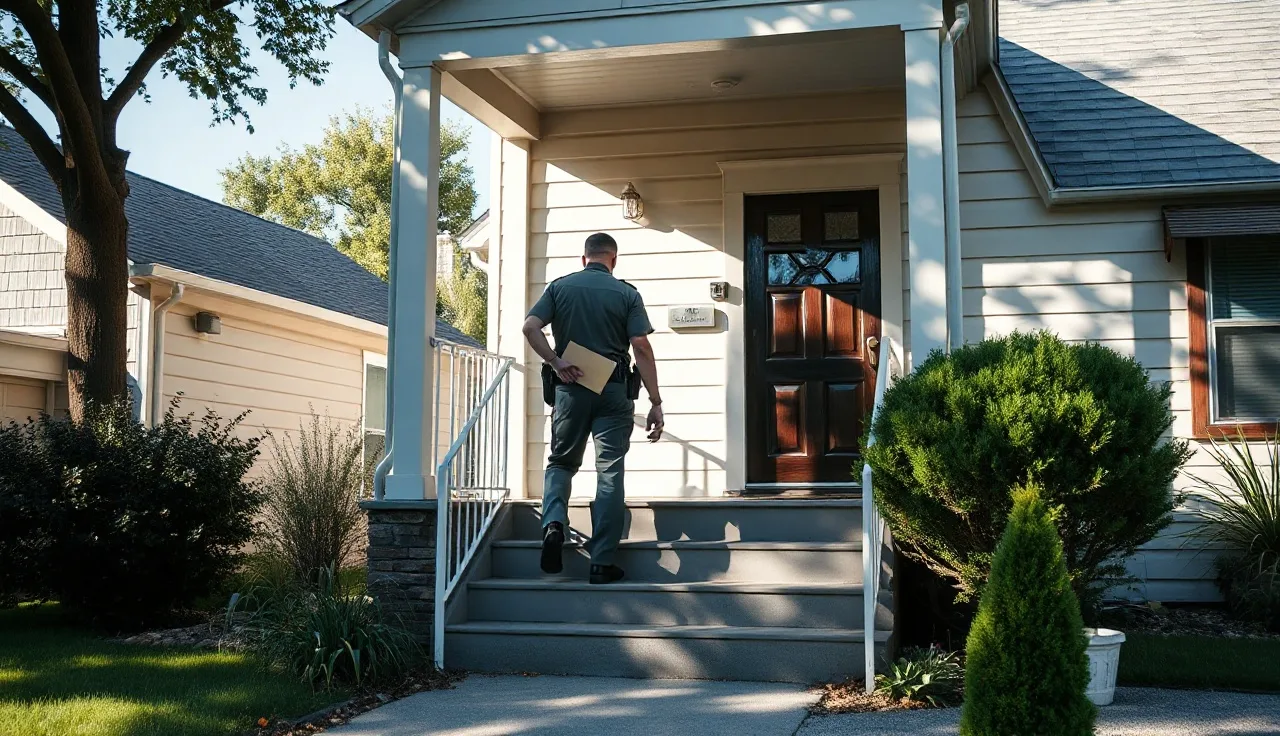
Sheriffs and constables are county-level law enforcement with civil process authority written into the job. Texas constables serve civil process as a primary statutory duty [2]. County sheriffs across the country run a civil process division for exactly this. So when people ask 'can police serve divorce papers,' picturing a uniformed officer at the door, the answer for sheriffs and constables is yes.
Municipal police officers (city cops) generally have no authority to serve civil papers while on duty. Their job is criminal enforcement. A few states hand municipal officers civil process authority in narrow cases, but counting on your local police department to deliver divorce papers is not a real plan in most of the country.
Want to know what your state allows? Read your state's Rules of Civil Procedure. California Code of Civil Procedure Section 414.10 authorizes service by a sheriff or marshal [3]. Florida Rule of Civil Procedure 1.070 authorizes the sheriff too. New York goes broader: CPLR Section 2103 lets any person over 18 who isn't a party to the action serve papers, so a private individual can serve with no official title at all [4].
The fastest free way to find the exact rule for your state is your state court's self-help center. The National Center for State Courts keeps a directory of those resources [5].
Who else can legally serve divorce papers?
Most states give you several options, and the sheriff is only one. Here's how they stack up:
| Method | Who does it | Typical cost | Best for |
|---|---|---|---|
| Sheriff / Constable | County law enforcement | $0 to $75 [6] | States where official service is preferred or required |
| Private process server | Licensed individual | $40 to $150 per attempt | Hard-to-find spouses, fast turnaround |
| Certified mail | USPS, return receipt | $5 to $15 | Cooperative spouses in states that allow it |
| Acknowledgment / Waiver | Spouse signs voluntarily | $0 | Uncontested divorces where spouse agrees |
| Publication | Newspaper notice | $50 to $300+ | Spouse whose location is unknown |
| Personal service by adult non-party | Friend or relative over 18 | $0 | States like New York, Illinois that allow it |
In an uncontested divorce with a cooperative spouse, the cheapest and least dramatic route is a signed Acceptance of Service or Waiver of Service form. Your spouse acknowledges receipt in writing, you file that document, and you skip the whole process server situation. Many state courts hand out this form for free. Check your court's self-help page before you pay anyone a dime.
Knowing what gets served matters as much as knowing who serves it. The packet of divorce papers usually includes the petition, the summons, and sometimes a financial disclosure form, depending on your state.
How much does it cost to have a sheriff serve divorce papers?
Sheriff service fees are set by state or county statute, so they swing widely. Some concrete numbers:
DivorceClear is a $149 one-time self-help document preparation and organization service for uncontested, simple-custody divorces. You answer questions in plain language and get a personalized preparation packet: your worksheets and numbers organized, a settlement completeness outline, and a county-specific filing roadmap, so you can get organized without paying an attorney $2,000 to $5,000. It is not a law firm and does not give legal advice; court forms, deadlines, and fees are set by your state and county, and for advice about your situation you should consult a licensed family law attorney. See what the packet includes.
DivorceClear is a $149 one-time self-help document preparation and organization service for uncontested, simple-custody divorces. You answer questions in plain language and get a personalized preparation packet: your worksheets and numbers organized, a settlement completeness outline, and a county-specific filing roadmap, so you can get organized without paying an attorney $2,000 to $5,000. It is not a law firm and does not give legal advice; court forms, deadlines, and fees are set by your state and county, and for advice about your situation you should consult a licensed family law attorney. See what the packet includes.
Certified mail is the bargain option at roughly $9 to $15. But not every state accepts it for divorce service, and it fails the moment your spouse refuses to sign.
DivorceClear is a $149 one-time self-help document preparation and organization service for uncontested, simple-custody divorces. You answer questions in plain language and get a personalized preparation packet: your worksheets and numbers organized, a settlement completeness outline, and a county-specific filing roadmap, so you can get organized without paying an attorney $2,000 to $5,000. It is not a law firm and does not give legal advice; court forms, deadlines, and fees are set by your state and county, and for advice about your situation you should consult a licensed family law attorney. See what the packet includes.
Here's what people miss: even cheap service adds up when it fails. If your spouse is dodging, budget for two or three attempts before the sheriff or server catches them home.
What are the rules for sheriff service in different states?
There's no single national rule. Each state's civil procedure code controls, and counties inside a state sometimes set their own fees. Below are the states people ask about most.
Texas: Constables and sheriffs both have civil process authority. You file your divorce petition, the clerk issues a citation (summons), and you take it to the constable's office or mail it in with a fee. The constable serves the citation and returns proof to you or the court. Texas Rules of Civil Procedure Rule 103 says who can serve [2].
California: CCP Section 414.10 authorizes the sheriff or marshal. You can also use a registered process server or any adult non-party. Personal service means the server hands the documents directly to the respondent [3].
Florida: The sheriff of the county where service happens is the default officer. A certified process server works too. Florida Rule of Civil Procedure 1.070(b) says original process is served by the sheriff or a special process server [6].
New York: New York is unusually permissive. CPLR Section 2103 lets any person over 18 who isn't a party serve the papers. The sheriff can do it, and so can a neighbor [4].
Illinois: 735 ILCS 5/2-202 authorizes the sheriff, a coroner, or a private process server licensed under the Private Detective, Private Alarm, Private Security, Fingerprint Vendor, and Locksmith Act [7].
If your state isn't here, your state court's self-help center is where to look. The National Center for State Courts directory at ncsc.org links to every state's self-help resources [5].
Can a police officer serve divorce papers if the spouse is avoiding service?
This is where sheriffs earn their keep. If your spouse is dodging, a sheriff's deputy has tools a private individual doesn't. They can get into apartment buildings, make repeat scheduled attempts, and in some states coordinate across jurisdictions. Nobody's staking out your ex's house for a week, but they take the job seriously.
Still, for a truly evasive spouse, a private process server is often more aggressive. Private servers work early morning or late evening, stake out a workplace, and team up with skip tracers. Sheriffs mostly work business hours.
If your spouse is really hiding, you may need to ask the court for substitute service (leaving papers with a responsible adult at the home) or service by publication (a newspaper notice run for a set number of weeks). Both usually need a court order. Publication is slow, expensive, and a last resort. Courts want proof you genuinely tried personal service first.
One rule holds everywhere: you cannot serve divorce papers yourself. Every state bars a party to the divorce from serving the papers. Sheriff, friend, or anyone else, the server has to be a neutral third party [1].
What proof of service do you need to file with the court?
After service happens, somebody has to prove it to the court. That proof is the affidavit of service or return of service: a sworn statement of who was served, when, where, and how.
When a sheriff or constable serves, they usually fill out the return themselves and either mail it to you or file it straight with the court, depending on the county. Ask the sheriff's civil division which route they use before you start, so you know whether to pick up the form or expect it to land in your case file.
Private process servers fill out a proof of service and hand it to you. Filing it with the clerk is your job.
If your spouse signed a waiver or acceptance of service, that signed document is your proof. File it with the clerk the moment it comes back.
Most state court websites post the right proof of service form. Some courts demand a specific form; others take any sworn statement with the required facts. When in doubt, use the court's official form.
Here's a real headache: courts bounce proof of service forms over tiny mistakes more often than they should. A missing date, a wrong address, or a blank notary line sends you back to the start. Read the form carefully before the server signs it.
What happens if divorce papers are not properly served?
The fallout ranges from annoying to serious. At minimum, your case stalls. The court won't enter a default judgment, set a hearing, or finalize anything until the file shows proper service or a signed waiver.
If you push through without proper service and somehow get a decree, that decree can be challenged later and possibly thrown out entirely. That's rare in practice but not impossible. A divorce obtained without proper notice to the other spouse violates due process under the Fourteenth Amendment and stays open to collateral attack [1].
The more common result is plain delay. The clerk hands your paperwork back, asks for corrected proof, and your timeline stretches. In an uncontested divorce where both of you want to be done, a service error stings.
If your spouse was served wrong and later claims they never got notice, you're looking at a contested hearing over whether service was valid. That can turn a cheap uncontested case into one that needs a divorce attorney.
Get service right the first time. This is not the place to wing it.
Can a friend or family member serve divorce papers instead of a police officer?
In many states, yes. New York, Illinois, and plenty of other states let any adult who isn't a party to the divorce serve the papers. A sibling, a coworker, a neighbor can hand your spouse the documents and then sign the proof of service.
The requirements are consistent in states that allow it: the server is over 18, isn't a named party in the divorce, and is willing to sign an affidavit describing what happened. Some states want that affidavit notarized.
This option costs nothing beyond a notary fee if one is required (usually $5 to $15). It's the go-to choice in states where it's legal, especially for uncontested divorces where the spouse will accept the papers without a fight.
The risk is human error. A friend who forgets the exact date, serves the wrong person, or fills out the affidavit wrong creates a mess. Brief your server carefully, have them read the form before they leave, and make sure they finish the affidavit the same day while the details are fresh.
Check your state's civil procedure rules first. If your state requires a sheriff or certified process server, a friend's affidavit won't hold up in court.
Is service by certified mail ever enough for a divorce?
Some states allow certified mail with return receipt for the initial service in a divorce. Others allow it only for later documents after the case is filed, not for the original summons and petition.
States that permit certified mail service usually require the envelope go to the respondent's last known address and require the green return receipt card (USPS Form 3811) to be signed by the respondent, more than any adult at the address. If your spouse refuses to sign or the mail comes back undelivered, you haven't served anyone and you're on to another method.
California allows service by mail with acknowledgment under CCP Section 415.30, but only if the recipient voluntarily signs and returns the acknowledgment form. It's basically a mailed version of a waiver. No signed form back, no service, and you're onto personal service [3].
Certified mail service fits when your spouse lives in another state, they're cooperative, and your state's rules allow it. It does nothing against a spouse who's avoiding you.
How do you get a sheriff to serve divorce papers step by step?
The sequence is similar in most states.
1. File your divorce petition with the court clerk. In most states the clerk issues a summons (sometimes a citation) at filing or shortly after. You need that summons before anyone can serve.
2. Take the summons, a copy of the petition, and any other required documents to the sheriff's civil process division in the county where your spouse lives. Many counties now take submissions by mail or online. Call ahead to confirm.
3. Pay the service fee and get a receipt. Fill out the sheriff's intake form, which asks for your spouse's address, physical description, workplace or alternate address, and the best times to find them home.
4. Wait. Sheriffs usually attempt service within 1 to 4 weeks, depending on workload. Rural counties can move faster. Busy urban counties take longer.
5. Get the return of service. The sheriff completes the affidavit and either sends it to you or files it directly with the court. If it comes to you, file it with the clerk fast. Your case can't move until that proof is in the file.
Haven't started your paperwork? Understanding the full set of divorce papers before you walk into the clerk's office saves you a return trip. DivorceClear's document packet covers the complete forms and instructions for your state, so you're not decoding the summons rules on your own.
Does the type of divorce affect how papers must be served?
Yes, in one big way. If your divorce is genuinely uncontested and your spouse cooperates, you can often skip formal service entirely with a signed waiver or acceptance of service. That's the cleanest path there is.
In a contested divorce, or any case where the spouse might dispute the process, formal personal service through a sheriff or licensed process server is safer. Proving service is easier when a professional did it and can testify.
Mediation and collaborative divorce assume cooperation from the start, so service by waiver is standard. If you're heading into a fight, paying a professional server who can back you up later is money well spent.
Your state's divorce law doesn't change based on how papers are served. Grounds, waiting periods, residency requirements, and property rules stay the same. Service is purely procedural. Get the procedure wrong, though, and everything else waits.
Frequently asked questions
Can a police officer refuse to serve divorce papers?
Municipal patrol officers can decline because civil process usually isn't their job. A sheriff's deputy in a civil process division generally can't refuse a properly submitted request, but they can fail to complete service if your spouse is never available. After several failed attempts, the sheriff's office returns the papers with a non-service note, and you'll need another method.
How long does a sheriff take to serve divorce papers?
Most sheriff's civil divisions finish service within 1 to 4 weeks when the address is right and the spouse is reachable. Busy urban counties take longer. Rural counties are sometimes faster. If you need speed, a private process server often serves within 24 to 72 hours. Ask the civil division for their current average turnaround before you assume the sheriff fits your timeline.
Can I serve my spouse divorce papers myself?
No. Every state bars a party to the divorce from serving their own papers. The server has to be a neutral third party: a sheriff, a process server, or in states that allow it, any adult friend who isn't named in the case. Serving papers yourself invalidates the service and can delay your case for weeks.
What if my spouse refuses to accept service from the sheriff?
In most states, personal service doesn't require the recipient to take the papers voluntarily. After identifying the person, the server can set the documents down near them, and service is still valid. This is called drop service. Your spouse can't dodge service just by refusing the envelope. Courts have upheld this approach consistently.
Do I need a process server or can the sheriff do it for cheaper?
DivorceClear is a $149 one-time self-help document preparation and organization service for uncontested, simple-custody divorces. You answer questions in plain language and get a personalized preparation packet: your worksheets and numbers organized, a settlement completeness outline, and a county-specific filing roadmap, so you can get organized without paying an attorney $2,000 to $5,000. It is not a law firm and does not give legal advice; court forms, deadlines, and fees are set by your state and county, and for advice about your situation you should consult a licensed family law attorney. See what the packet includes.
Can divorce papers be served at someone's workplace?
Yes, in most states. Personal service is valid wherever the person is physically found, workplace included, unless a specific statute bars it. Some servers prefer the workplace because the spouse is reliably there. But serving someone at work can embarrass them and sour an otherwise amicable divorce, so weigh that before making it your first move.
What happens if the sheriff can't find my spouse to serve them?
The sheriff returns the papers with a note on the failed attempts. From there you can hire a private process server with skip-trace ability to find a new address, request substitute service (leaving papers with an adult at the residence), or ask the court to allow service by publication in a newspaper. Publication is a last resort and usually requires showing you made genuine good-faith efforts first.
Does a spouse have to be served in the same state where the divorce is filed?
Not necessarily. Service can happen across state lines in most cases. The summons your state's court issues is valid in other states under long-arm statutes, and you'd usually use a process server or sheriff in the state where your spouse lives. Some states require specific steps for out-of-state service, so check your state's rules or self-help center.
Is service by email or social media ever valid for divorce papers?
Rarely, and only with a court order. A few states have allowed service by social media or email when the spouse can't be found any other way and their online presence is verified. It takes a judge's approval first plus documented proof that traditional service has been exhausted. Don't try email service without that order; the court won't recognize it.
How much does it cost to serve divorce papers total?
DivorceClear is a $149 one-time self-help document preparation and organization service for uncontested, simple-custody divorces. You answer questions in plain language and get a personalized preparation packet: your worksheets and numbers organized, a settlement completeness outline, and a county-specific filing roadmap, so you can get organized without paying an attorney $2,000 to $5,000. It is not a law firm and does not give legal advice; court forms, deadlines, and fees are set by your state and county, and for advice about your situation you should consult a licensed family law attorney. See what the packet includes.
Can a constable serve divorce papers?
Yes. In states like Texas, constables are the primary civil process officers, and serving court papers is a core part of the job. Texas Rules of Civil Procedure Rule 103 names constables alongside sheriffs. Constable fees vary by county. In some Texas counties, constable service is faster and cheaper than the sheriff's office, so call both to compare.
What form proves that a sheriff served the divorce papers?
It's the return of service or affidavit of service, and the sheriff's office fills it out after delivering the papers. The form lists who was served, plus the date, time, location, and method. The sheriff either files it directly with the court or sends it to you to file. It has to be in your case file before the court can set hearings or enter any orders.
Sources
- U.S. Constitution, Fourteenth Amendment, Due Process Clause: No person may lose legal rights without notice and an opportunity to be heard; service of process is the constitutional mechanism for that notice in civil cases.
- Texas Rules of Civil Procedure, Rule 103: Texas Rule 103 names sheriffs and constables as authorized servers of civil process, including divorce citations.
- California Code of Civil Procedure, Sections 414.10 and 415.30: CCP 414.10 authorizes the sheriff or marshal to serve civil process in California; CCP 415.30 allows service by mail with voluntary acknowledgment.
- New York Civil Practice Law and Rules, Section 2103: CPLR 2103 allows any person over 18 who is not a party to the action to serve papers in New York.
- National Center for State Courts, Self-Help Center Directory: NCSC maintains a directory of state court self-help resources where filers can locate state-specific service rules.
- Florida Rules of Civil Procedure, Rule 1.070: Florida Rule 1.070(b) provides that service of original process is made by the sheriff of the county where service is made, or by a special process server.
- Illinois Compiled Statutes, 735 ILCS 5/2-202: Illinois 735 ILCS 5/2-202 authorizes the sheriff, coroner, or a licensed private detective to serve civil process.
- U.S. Courts, Federal Rules of Civil Procedure, Rule 4: Federal Rule 4 governs service of process at the federal level and provides the framework that most state rules are modeled on.
- California Courts Self-Help Center: California's self-help center reports that sheriff service fees are $40 per defendant for the first address served.
- Florida State Courts, Family Court Resources: Florida sheriff service fees vary by county and commonly run approximately $40 per service attempt for civil process.