Last updated 2026-07-11
TL;DR
Service by publication is a court-approved way to serve divorce papers on a spouse whose location you genuinely cannot find after a documented search. You run a legal notice in a qualifying local newspaper for a set number of weeks (usually 3 to 4), file proof with the court, then move toward a default. Most states require a judge's permission first. It adds 6 to 12 weeks and $50 to $500 in publication costs.
What is service by publication in a divorce case?
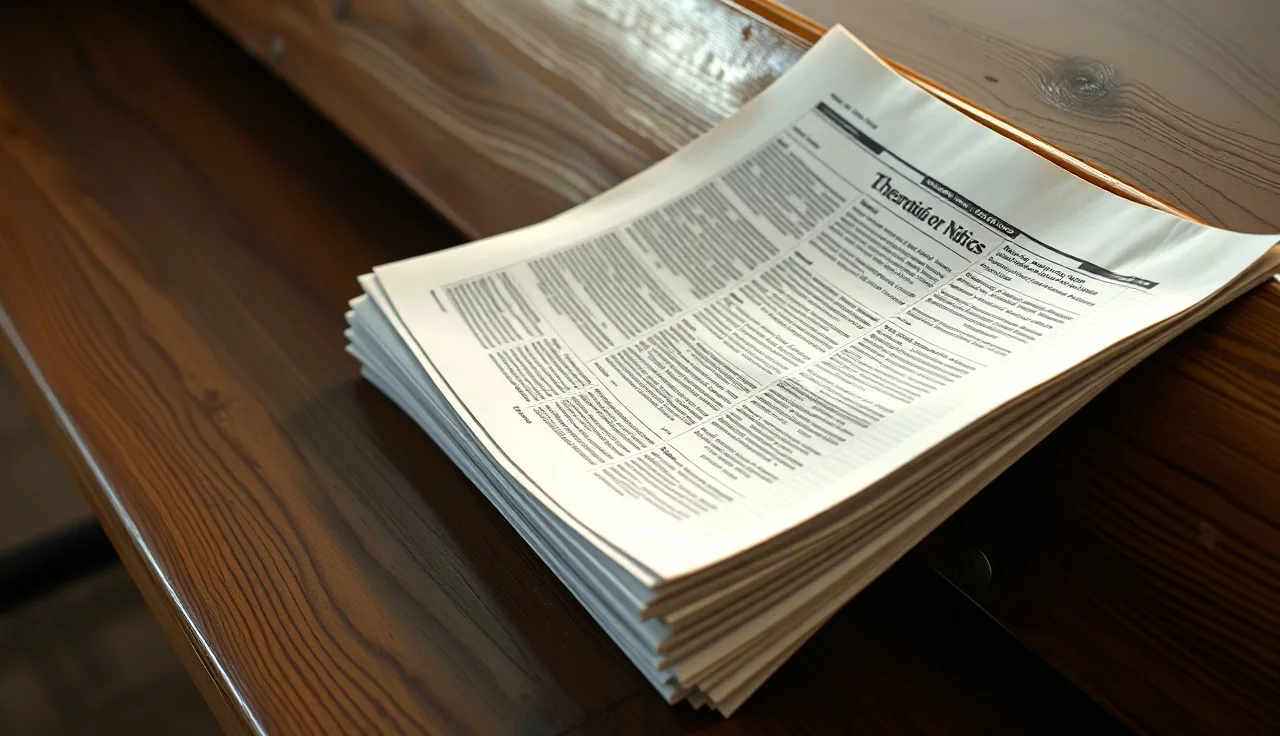
Service by publication means the court lets you notify a missing spouse of the divorce by running a formal notice in a newspaper instead of handing them papers in person. It is a legal fiction, and everyone involved knows it. The law presumes your spouse had a chance to learn about the case once the notice runs, even if they never saw a single line of it.
Every state requires that divorce papers be formally "served" on the other spouse. That rule exists because the Constitution's due process clause demands a person get notice before a court enters a judgment affecting their rights [1]. When you can't find someone, personal service is impossible. Publication is the fallback the courts have leaned on for more than a century.
A divorce by publication usually ends in a default judgment. Your spouse didn't respond, or couldn't, so the court grants the divorce on your terms, subject to real limits. Most states won't award you property sitting in another state through a publication-only case. Some won't issue custody orders unless the child and the other parent have enough connection to the state to establish jurisdiction. Learn those limits before you spend a dime.
Some states call this "service by posting" when they let you tack a notice at the courthouse instead of, or on top of, a newspaper run. The rules are state-specific. Check your state court's self-help page before you assume the newspaper route is your only path.
When can you use service by publication in a divorce?
You can use it only after a genuine, documented search turns up nothing. Courts call this the "diligent search" or "due diligence" requirement, and they enforce it. Judges reject publication requests all the time when a petitioner skipped the obvious steps.
A diligent search generally means you tried, and can prove you tried, most of the following: checking the last known address and talking to neighbors or a landlord, searching social media, contacting relatives and friends, checking voter registration, running the spouse through the DMV or state licensing boards, using the court's access to the Social Security Administration address program if your state offers it, and checking military locator services if the spouse might be in the armed forces [2]. You usually don't need a private investigator, though some judges expect one if your search took an afternoon.
You cannot use publication because service is inconvenient, because the spouse is dodging you, or because you'd rather not pay a process server. If your spouse is hiding but you know their city, most courts expect you to attempt service by mail, by a sheriff, or by a process server at known addresses first.
States that have written the requirement into law include California (Family Code Section 415.50) [3], Florida (Rule of Civil Procedure 1.070(d)) [4], and Texas (Rule of Civil Procedure 109) [5]. The checklist shifts state to state. The idea behind it does not.
How does service by publication actually work, step by step?
The process runs in five stages. They happen in order, and you can't skip any of them.
1. File your petition first. You need a pending divorce case before you can publish anything. If you haven't filed, start there. Your divorce papers go to the clerk, you pay the filing fee, and you get a case number. That case number goes into the notice.
2. Conduct and document your diligent search. Do the searches described above. Keep receipts, screenshots, dates, and the names of everyone you contacted. All of it goes into an affidavit.
3. File a motion or affidavit asking for permission to publish. Most states require a sworn statement (an affidavit of diligent search, or a motion for alternative service) that walks through every step you took and explains why personal service is impossible. The judge reviews it and signs an order allowing publication [2]. Some states, Florida among them, require the signed order before any notice can legally run.
4. Publish the notice in a qualifying newspaper. The order or the statute tells you what the paper must be: usually a newspaper of general circulation in the county where the case is filed, or where the spouse was last known to live. Call the paper's legal notices department, hand them the required language (your state sets it by statute or rule), and they run it for the required number of consecutive weeks. Most states want 3 or 4 [3][4][5]. Some want once a week; some want several insertions a week. Read that part twice.
5. File proof of publication. After the run ends, the newspaper sends you an affidavit of publication (some call it a publisher's affidavit). File it with the clerk. In most states the response clock starts on the date of the last publication and runs 20 to 30 days before you can ask for a default.
What does the published notice have to say?
The wording is not up to you. State law or court rules set the required language, and a notice missing a required element is legally void. Get it right the first time or you publish again.
At a minimum, a divorce publication notice includes the names of both parties, the case number, the name of the court, a short statement that a divorce has been filed, and an instruction that the respondent has a deadline to respond or a default may be entered against them. Some states also require the date the petition was filed and the relief you're asking for, such as division of property or spousal support.
Your county court's self-help center, or your state court's online self-help portal, is where you get the correct template. Do not draft the notice from scratch. A single missing field can void the run and send you back to the start.
The newspaper's legal notices department has done this hundreds of times and can usually tell you whether your draft hits every required element. That's a free second set of eyes. Take it.
How much does service by publication cost?
Costs fall into two buckets: court costs and newspaper fees. Plan on $50 to $500 total in most cases, almost all of it going to the paper.
The affidavit of diligent search and the motion for alternative service usually carry no extra filing fee beyond your original petition, though some courts charge a small motion fee (typically under $50).
Newspaper fees swing hard. A rural weekly might charge $40 to $80 for four weekly insertions. A daily in a large metro can charge $200 to $500 or more for the same run [6]. The state does not set newspaper rates. You can call around to qualifying papers in the county and pick the cheapest, as long as it fits the statutory definition of a "newspaper of general circulation" where you filed.
The table below shows approximate publication cost ranges for a four-week run across a sample of states, drawn from courthouse self-help pages and newspaper legal notice rate cards.
| State | Typical low end | Typical high end | Required weeks |
|---|---|---|---|
| California | $75 | $350 | 4 |
| Florida | $60 | $250 | 4 |
| Texas | $50 | $300 | 4 |
| New York | $100 | $500 | 4 |
| Illinois | $50 | $200 | 3 |
| Georgia | $50 | $175 | 4 |
| Ohio | $50 | $150 | 6 |
These are estimates. Call the legal notices desk at two or three qualifying papers and get real quotes before you budget. Ohio's six-week requirement is not a typo. Some states run longer [7].
If cost is a barrier, ask the clerk whether a fee waiver (in forma pauperis) reaches publication costs. In some states the court itself arranges publication through a qualifying outlet at reduced or no cost for low-income filers.
How long does service by publication take?
Add at least 6 to 10 weeks to whatever your normal divorce timeline would be. All in, a publication case realistically takes 3 to 5 months from filing to final decree, even when nothing else is complicated.
Getting a judge's signature on the motion to publish takes 1 to 3 weeks, depending on the court's calendar. The publication itself runs 3 to 6 weeks. After the last publication date, the respondent gets a response window, usually 20 to 30 days. No response means you file for default and set a hearing. A backlogged court might schedule that hearing 2 to 4 weeks out.
A procedural error that forces you to re-publish resets a chunk of that clock. Slow down and get each step right.
If your spouse is in the military, stop and read the Servicemembers Civil Relief Act (SCRA) before you go further [8]. The SCRA lets active-duty servicemembers request a stay, and a default judgment entered against an active-duty servicemember in violation of the act can be vacated. The Department of Defense's Defense Manpower Data Center runs a free public database to check military status [9].
What can the court order when service is only by publication?
This is the part people skip, and it comes back to bite them. A publication-only divorce can end your marriage but usually cannot make an absent spouse pay you a dime.
A court has two kinds of power: power over the people in the case ("in personam" jurisdiction) and power over property or a legal status ("in rem" or "quasi in rem" jurisdiction). Because the respondent never appeared, service by publication usually gives the court only the second kind.
What that means in practice: the court can dissolve the marriage (change your status from married to single) and divide property physically located in the state. It generally cannot enter a personal money judgment against the absent spouse, cannot reliably order alimony the other party must pay, and has limited power to issue enforceable child support orders unless the child has lived in the state long enough to establish jurisdiction under the Uniform Child Custody Jurisdiction and Enforcement Act (UCCJEA) [10].
If you have real property, a live custody question, or you need alimony, a publication-only divorce may not get you what you need. That's a moment where a consult with a divorce attorney earns its fee.
One more thing. If your spouse later surfaces and shows they had no actual notice, they may be able to challenge the judgment, especially the property or custody pieces. The change of marital status is harder to unwind. The rest is vulnerable.
What happens if my spouse responds after publication?
It happens. The notice runs, your spouse sees it or hears about it from someone, and they show up.
Respond within the deadline in the publication order, and the case proceeds as a normal contested or uncontested divorce. You don't lose. It just means you both have to work through it. The publication wasn't wasted. It's the thing that pulled them into the case.
Respond after the deadline but before a final decree, and most judges will let them participate anyway. Courts don't like entering judgments against people who are actively trying to take part. Check your local rules, but a motion to vacate the default in that window has a decent shot.
Appear after the decree is entered, and things get harder. That's the point where you really do want a divorce lawyer.
Are there alternatives to service by publication?
Yes, and one of them is probably better for you. Most states now allow other forms of alternative service that run faster, cost less, or reach your spouse more reliably than a newspaper ever will.
Service by mail to the last known address is allowed in many states when personal service has failed. California Family Code Section 415.40, for example, allows service by first-class mail plus a notice and acknowledgment form for out-of-state respondents [3]. That's simpler than publication if you have a plausible address.
Service by email or social media is allowed by court order in a growing number of places. New York courts have granted orders permitting service through Facebook. Texas amended its rules in 2020 to explicitly allow social media service with a court order (Rule of Civil Procedure 106(b)) [5]. It's newer, and you still need the judge's sign-off, but if you know your spouse's active accounts, it beats a newspaper run on speed and cost.
Posting at the courthouse is still on the books in some states as a cheaper option than newspaper publication, though courts treat it as a weaker form of notice.
The right choice turns on your state's rules and what you actually know about where your spouse is. Got a thread to pull? Pull it before you commit to publication.
How do I find the right newspaper and file the proof correctly?
Start by confirming which papers qualify. Your statute or court order will say the notice must run in a "newspaper of general circulation" published in a specific county. Some states keep lists of qualifying legal notice newspapers. California superior courts, for instance, maintain adjudicated newspaper lists [11]. If your state has one, use it. If not, call the clerk and ask which papers they routinely see for legal notices.
Contact the paper's legal notices or public notices department directly. Tell them you have a divorce notice, give them the case number and county, and ask for a quote and their process. They'll ask for the required notice language. Give it to them from your court's template, not from memory.
After the run ends, the newspaper sends you (or lets you pick up) an affidavit of publication. It's a sworn statement from a newspaper representative certifying the dates the notice ran, with a clipping or printout of the actual notice attached. File the original with the clerk and keep a copy. Some courts want it on file before they'll schedule your default hearing. Others just want it in the file by the hearing itself.
If you built your divorce paperwork through a document preparation service like DivorceClear, the service won't handle publication for you. That's a court-supervised process that changes county to county. But having your petition and judgment forms already done right saves real time and cuts the risk of an error that forces a redo.
What are the most common mistakes people make with service by publication?
The errors cluster in five predictable spots, and every one of them can cost you weeks.
First, publishing before getting the court's permission. Many states require a signed order before publication counts. Publishing on your own and trying to get the order after the fact usually fails and burns your publication fee.
Second, using the wrong newspaper. Pick a paper that doesn't meet the statutory definition for your county, and the publication is a nullity. Confirm before you pay.
Third, skimping on the diligent search documentation. Judges read these affidavits closely. A half-page affidavit saying "I looked around and couldn't find them" gets rejected. List every step, every date, every person, every database.
Fourth, getting the notice language wrong. Some states require verbatim text. Others allow variation but demand certain fields. Have the self-help center or the newspaper's legal notices staff review your draft before it runs.
Fifth, sitting on the proof of publication. People get the newspaper's affidavit and let it gather dust, not realizing the response clock (in many states) doesn't start until the last publication date, and the court won't move toward default until the proof is in the file. File it the day you get it.
For a wider view of how paperwork errors pile up across a case, read how divorce papers flow from filing to decree before you reach the service stage.
Frequently asked questions
Can I get a divorce if I have no idea where my spouse is?
Yes. That's the exact situation service by publication is built for. You file your petition, document your attempts to find your spouse, get the court's permission to publish, run the notice in a qualifying newspaper for the required weeks (usually 3 to 4), file proof with the court, then request a default judgment. The divorce can be granted even if your spouse never responds or never sees the notice.
Does service by publication actually notify my spouse?
Realistically, probably not. A newspaper of general circulation is rarely the first place someone in hiding looks. The legal system admits the fiction: publication satisfies the constitutional due process requirement by creating a reasonable opportunity for notice, even when actual notice never lands. That's why courts limit it to cases where every other method has already failed.
How long do I have to search before I can request publication?
Most states set no minimum time. Thoroughness is what counts, not the calendar. A two-week search that checked every reasonable source usually clears the bar. A six-month search that amounted to driving past one address does not. Courts weigh the scope of the search, not how long it dragged on. Document every step you took, the date, and the result.
What is a diligent search affidavit and what should it include?
It's a sworn statement you file explaining every step you took to find your spouse. List each source you checked (DMV, voter registration, social media, relatives, last known employer, USPS address forwarding), the date you checked it, and the result. Many state courts provide a form. Florida, for example, has a standardized diligent search affidavit that spells out the required steps.
Can I use social media instead of a newspaper for service by publication?
In a growing number of states, yes, but only with a court order that specifically authorizes it. Texas Rule of Civil Procedure 106(b) explicitly allows social media service by court order. New York courts have approved Facebook service in individual cases. You still have to show a newspaper run would be ineffective and that the account is demonstrably active and belongs to your spouse. Worth asking the court about.
What happens to child custody and child support in a publication divorce?
It gets complicated. A court can issue custody orders only with jurisdiction under the UCCJEA, which generally requires the child to have lived in the state at least six months. Child support requires personal jurisdiction over the paying parent. If your spouse was served only by publication, enforcing a support order against them in another state is hard. For any case with children, talk to a family law attorney before relying on publication alone.
How do I know which newspaper qualifies for legal publication in my county?
Your state statute defines what counts as a "newspaper of general circulation." Many states go further and publish adjudicated newspaper lists that courts have approved for legal notices. California superior courts, for example, keep county-level lists. Check your state court's self-help website, call the clerk's office, or read the court's local rules. The paper's legal notices department will usually know whether they qualify.
How much does it cost to publish a divorce notice in a newspaper?
Roughly $50 to $500, depending on the paper and how many insertions your state requires. A small rural weekly might charge $40 to $80 for a four-week run. A large metro daily can charge $300 to $500 for the same run. Call two or three qualifying papers and compare rates before you commit. If cost is a hardship, ask the court about fee waivers that might cover publication.
Can my spouse contest the divorce after it's granted by default through publication?
Potentially, depending on timing and what they're challenging. If they can show they had no actual notice and move fast, some courts will vacate the property or custody portions of a default judgment. The dissolution of the marriage itself is much harder to undo. That's one reason publication divorces carry more long-term risk on financial and custody issues than cases where the spouse was personally served.
Do I need a lawyer to do service by publication?
No, but the process has enough moving parts that self-represented filers trip on it often. The diligent search affidavit, the motion to publish, the notice language, the proof of publication filing: each carries requirements that vary by state and sometimes by county. Court self-help centers can walk you through the forms without giving legal advice. If children or significant assets are in play, a consult with a divorce attorney is worth the money.
What is the difference between service by publication and service by posting?
Service by publication means running a notice in a qualifying newspaper. Service by posting means physically posting the notice at the courthouse or another public place the court designates. Some states allow posting as an alternative to newspaper publication. Others require both. Posting is generally cheaper, but courts often treat it as weaker notice. Check your state's rules on which alternatives are available to you.
What is the response deadline after service by publication?
Most states give the respondent 20 to 30 days after the last date of publication to respond. Some states measure from the first publication instead. The order permitting publication usually states the deadline outright. Don't guess: read the order and your state's rules carefully. Filing for default before the response window closes is a common mistake that only delays your case further.
Do I still need to divide property correctly even in a publication divorce?
Yes, and extra limits apply. A court acting only through publication can divide property physically located in the state but typically can't enter a personal money judgment against the absent spouse or divide property in other states. If your marital estate includes out-of-state real property, retirement accounts, or business interests, the publication route may not resolve them. Get specific legal guidance before proceeding if that's your situation.
Sources
- U.S. Constitution, Fourteenth Amendment, Cornell Law School LII: Due process requires that a person receive notice before a court enters a judgment affecting their rights, forming the constitutional basis for service of process requirements.
- Florida Courts Self-Help Center, Service of Process by Publication: Florida requires a court order before publication begins and mandates a diligent search affidavit listing specific search steps taken before the court will approve alternative service.
- California Family Code Section 415.50, California Legislative Information: California Family Code Section 415.50 governs service by publication and requires a court order finding that the party's address is unknown, and that a diligent search was made.
- Florida Rules of Civil Procedure Rule 1.070(d), Florida Legislature: Florida Rule 1.070(d) requires publication once per week for four consecutive weeks in a newspaper of general circulation in the county where the action is pending.
- Texas Rules of Civil Procedure Rules 106(b) and 109, Texas Courts: Texas Rule of Civil Procedure 109 authorizes service by publication when personal service is impracticable, and Rule 106(b) was amended in 2020 to explicitly allow social media service with a court order.
- Texas Legal Notice Rates, Public Notice Texas (Texas Press Association): Newspaper legal notice rates for a four-week publication run vary significantly by market, ranging from approximately $50 in small markets to $300 or more in major metropolitan areas.
- Ohio Rules of Civil Procedure Rule 4.4, Ohio Legislature: Ohio Rule 4.4 requires publication once a week for six successive weeks when service by publication is ordered, longer than the four-week requirement in most other states.
- Servicemembers Civil Relief Act (SCRA), 50 U.S.C. §§ 3901-4043, Cornell Law School LII: The SCRA gives active-duty servicemembers the right to request a stay of civil proceedings, and default judgments entered in violation of the SCRA may be vacated.
- Defense Manpower Data Center (DMDC) Military Verification, U.S. Department of Defense: The DMDC maintains a free public database that individuals and courts can use to verify whether a person is currently on active duty in the U.S. armed forces.
- Uniform Child Custody Jurisdiction and Enforcement Act (UCCJEA), Uniform Law Commission: The UCCJEA, adopted in 49 states, generally requires a child to have lived in the state for at least six months for that state to have jurisdiction to issue custody orders.
- California Courts Self-Help Center, Service of Process: California superior courts maintain county-level lists of adjudicated newspapers qualified to carry legal notices, which filers should use to confirm a paper qualifies before publishing.