Last updated 2026-07-11
TL;DR
Most state courts accept cash, money orders, cashier's checks, and (increasingly) credit or debit cards for divorce filing fees. Personal checks are accepted at some clerks' offices but rejected at others. Filing fees range from about $75 to $435 depending on your state. Call the clerk's office before you go, because accepted payment methods vary by county and can change without notice.
Why does the payment method even matter at the courthouse?
A rejected payment means your divorce papers don't get filed that day. The clerk stamps your documents with the date only after the fee clears. Show up with a personal check in a county that doesn't take them, or a credit card in a courthouse that only takes cash, and you leave empty-handed. Then you drive back.
This is more than a minor inconvenience. In some states, the date of filing triggers legal protections, like freezing the marital estate or starting the mandatory waiting period. A one-day delay can matter.
Courts are also not consistent across counties within the same state. One California Superior Court may take Visa; the one three counties over may be cash and money order only [1]. The only reliable way to know is to check the specific court's website or call the clerk's window directly.
What payment methods do most divorce courts accept?
Here's the honest picture across most U.S. jurisdictions:
| Payment Method | Widely Accepted? | Notes |
|---|---|---|
| Cash (exact change) | Yes, almost everywhere | Some offices can't make change; exact amount is safest |
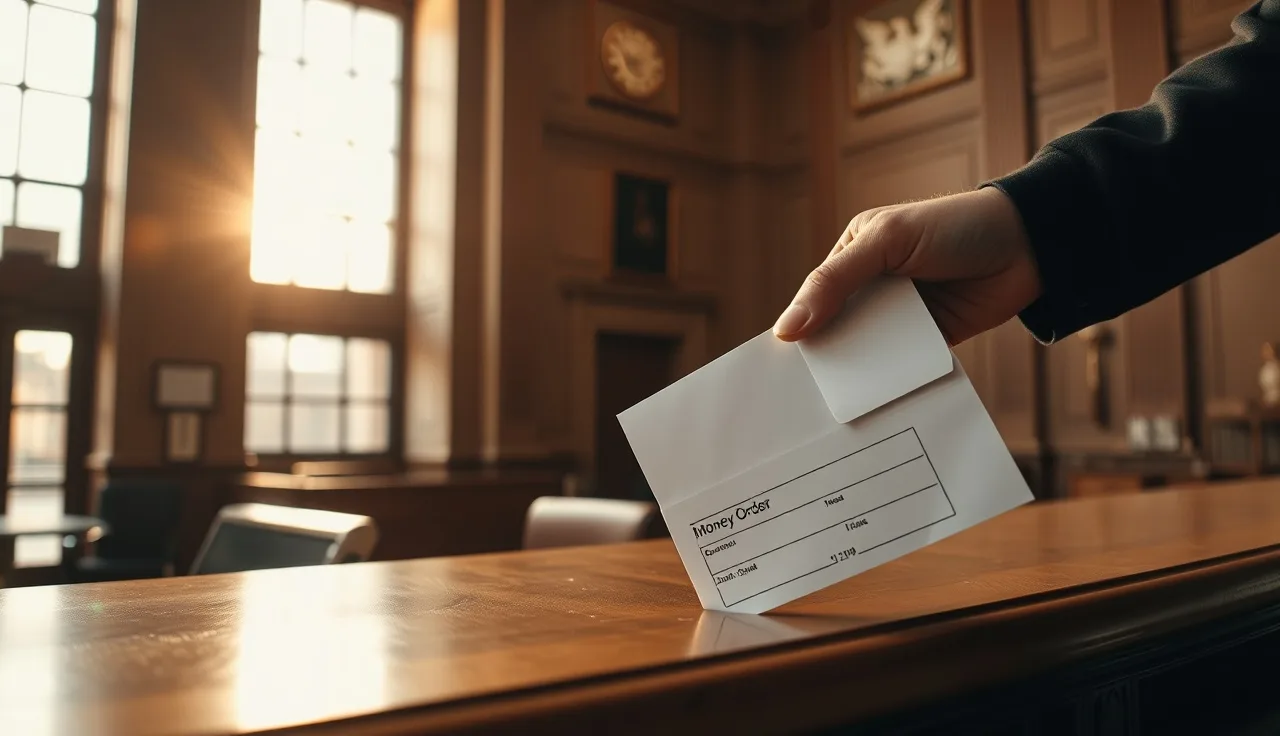
| Money order | Yes, almost everywhere | Made out to the court clerk or county; confirm exact payee name |
| Cashier's check | Yes, almost everywhere | Same payee naming caution as money orders |
| Credit card (Visa/MC) | Increasingly yes | Often carries a 2.5%, 3.5% convenience fee [2] |
| Debit card | Often yes, same terminal as credit | Same convenience fee usually applies |
| Personal check | Hit or miss | Many courts stopped accepting them; call ahead |
| Online payment portal | Growing but uneven | Some courts let you pay at e-filing; others still require in-person |
| Cryptocurrency or payment apps | No | No U.S. court accepts these for filing fees |
Cash and money orders are the safe defaults. If you can't find current information online, bring a money order made out to the clerk of court for your county, plus a little extra cash in case there's a small balance discrepancy.
Credit and debit cards have spread a lot since 2020, partly because courts sped up their technology upgrades during the pandemic. But the convenience fee is real, and it's usually not optional. On a $300 filing fee, a 3% fee adds $9. Not ruinous, but worth knowing.
How much is the divorce filing fee I'll actually be paying?
DivorceClear is a $149 one-time self-help document preparation and organization service for uncontested, simple-custody divorces. You answer questions in plain language and get a personalized preparation packet: your worksheets and numbers organized, a settlement completeness outline, and a county-specific filing roadmap, so you can get organized without paying an attorney $2,000 to $5,000. It is not a law firm and does not give legal advice; court forms, deadlines, and fees are set by your state and county, and for advice about your situation you should consult a licensed family law attorney. See what the packet includes.
A few representative examples, pulled from state court self-help or clerk fee schedules:
- California: $435 for the petition, $435 for the response (each party pays to file) [3]
- Florida: approximately $408 in most counties [4]
- Texas: $250, $350 depending on county, with additional fees for a decree [5]
- New York: $210 for an uncontested divorce (index number) plus additional processing fees [6]
- Illinois: varies by county, roughly $200, $400 in Cook County [7]
These are the court's fees only. They don't include process server fees, certified copy fees, or anything else. The total out-of-pocket cost to file and serve an uncontested divorce typically runs $300, $600 even before attorney fees.
Can't afford the filing fee? Almost every state has a fee waiver process (usually called an application to proceed in forma pauperis). The clerk's office has the form, or you'll find it on the court's self-help page [1].
Does it cost extra to pay by credit card at the courthouse?
Usually yes. Courts that accept credit and debit cards almost universally charge a convenience fee, because they pay a transaction processing fee to whoever runs their payment terminal, and state law typically prohibits the court from absorbing that cost into its general budget.
The fee is usually 2.5% to 3.5% of the transaction [2]. Some jurisdictions use a flat fee instead, like $5.00 per transaction regardless of amount. Either way, you'll see it disclosed before you swipe or tap.
A few courts have shifted to e-check (ACH) as a cheaper alternative. ACH fees are often $1, $3 flat. If your court's online portal offers e-check, that's frequently the cheapest card-adjacent option short of walking in with a money order.
If you're paying a large total because both spouses are filing (California being the obvious example at $435 each), the credit card surcharge can add $20, $30. At that point, a cashier's check or money order saves real money.
Can you pay divorce filing fees online?
Some courts, yes. Online filing portals (often called e-filing systems) are now mandatory or at least available in many states for civil cases, and divorce is a civil filing. States like California, Texas, Illinois, and New York run e-filing systems where you can submit your documents and pay in the same session [7].
But e-filing is not universal. Many smaller counties still require you to walk papers in. And even in states with e-filing, some courts exempt self-represented filers from the e-filing mandate, so you can still file in person if you prefer.
When you pay online, the accepted methods are usually credit card, debit card, and e-check. Cash isn't an option digitally, for obvious reasons.
One practical note: online portals sometimes charge a separate "system fee" on top of the court filing fee and the credit card convenience fee. Read the checkout screen carefully before you confirm. The total can be $15, $30 higher than the stated filing fee.
If your divorce paperwork is already prepared (including all the forms required in your county), e-filing is generally faster than an in-person trip. If you're preparing divorce papers for the first time and want them done right before you file, getting the forms organized matters as much as the payment question.
Do courts accept personal checks for divorce filing fees?
Some do. Many don't. This is one of the most variable things about the filing process, and it shifted noticeably after 2015 as more courts moved away from personal checks to cut returned-check risk and administrative processing time.
If a court does accept personal checks, it typically requires a state-issued ID to match the check, and it will note your driver's license number on the check. A returned check almost always triggers an additional fee ($25, $50) and can result in your filing being voided.
The clerk's office website is the best place to confirm. If the website doesn't say, call. Don't assume.
My honest recommendation: use a money order even if personal checks are technically allowed. It costs a couple of dollars at the post office or Walmart, it clears instantly, and it removes any doubt. The only time I'd use a personal check is if the clerk explicitly tells you over the phone that it's fine and there's no other option.
How do I find the exact payment rules for my specific court?
Three steps, in order:
1. Go to your county court's official website (search for "[county name] clerk of court" or "[county] superior/district/circuit court"). Look for a fee schedule or "how to file" page. Many now post accepted payment methods explicitly.
2. If the website is ambiguous or out of date (many are), call the civil division clerk's office directly. The number is on the same website. Ask specifically: "What forms of payment do you accept for a divorce petition filing fee, and do you accept personal checks?"
3. If you're using e-filing, check the e-filing portal's FAQ. Texas, for example, uses Tyler Technologies' Odyssey system statewide, and it posts its payment rules clearly [5].
Most state courts also run self-help centers, either in the courthouse or online, specifically for people representing themselves. The California Courts self-help page, for example, lists fee schedules and waiver options [1]. Florida's clerks of court publish their fee schedules by county [4]. These are worth bookmarking.
Not sure whether your divorce papers are complete before you go to file? Resolve that first. Filing incomplete documents and having them rejected means you've paid the fee without getting a case number, and some courts handle that refund process slowly.
What if I can't afford the filing fee? Are there waivers?
Yes, and they're more available than most people realize. Every state has a way to waive or defer court fees for people who can't afford them. The legal term is proceeding "in forma pauperis" (IFP), though some states use plainer language like "fee waiver application" or "inability to pay" affidavit [8].
Eligibility typically ties to income, public benefits, or both. If you're receiving Medi-Cal, SNAP, SSI, or similar benefits, you often qualify automatically. If you're not on public assistance, most courts use a threshold around 125% to 200% of the federal poverty level [8].
The federal poverty guidelines are updated annually by the Department of Health and Human Services [9]. For 2025, 125% of the poverty line for a single person is approximately $19,163; for a family of four, roughly $39,750. Courts generally apply the guideline for the year in which you file.
To apply, you fill out a form (the clerk provides it, or it's on the court's website), attach proof of income or benefits, and submit it with your divorce petition. The judge reviews it, sometimes the same day. If granted, you owe nothing at filing. Some courts grant deferrals instead of full waivers, meaning you pay later from any assets received in the divorce.
Fee waivers are completely legitimate. There's no disadvantage to your case for having asked.
What exactly should I bring to the courthouse to pay my filing fee?
Here's what I'd have ready before walking in:
- A money order (or cashier's check) for the exact filing fee amount, made out to "Clerk of Court, [County] County" or whatever the court's instructions specify. Confirm the payee name online or by phone.
- A small amount of cash for any add-on fees you weren't expecting (certified copy fees, sheriff's service fees, and the like).
- Your government-issued photo ID.
- A copy of every document you're filing, so if anything is rejected you know exactly what needs to change.
If you're certain the court takes credit cards and you're fine with the convenience fee, your card works. Just know the terminal may be chip-only or may not accept contactless, so bring a card you can insert.
Filing in a high-volume urban court (Los Angeles, Cook County, Harris County)? Expect a line. Arrive early. Some clerk's offices stop accepting filings an hour before they close.
DivorceClear is a $149 one-time self-help document preparation and organization service for uncontested, simple-custody divorces. You answer questions in plain language and get a personalized preparation packet: your worksheets and numbers organized, a settlement completeness outline, and a county-specific filing roadmap, so you can get organized without paying an attorney $2,000 to $5,000. It is not a law firm and does not give legal advice; court forms, deadlines, and fees are set by your state and county, and for advice about your situation you should consult a licensed family law attorney. See what the packet includes.
Do both spouses have to pay a filing fee in a divorce?
Only the petitioner (the spouse who files first) pays the initial filing fee. In an uncontested divorce, the respondent (the other spouse) typically needs to either file an Answer/Response or sign a waiver of service and acceptance of service form. Whether the respondent's filing triggers another fee depends on the state.
In California, if the respondent files a formal Response, they pay their own $435 fee [3]. If they file only a limited response or a waiver of appearance, there may be no fee for that filing.
In many other states, the respondent in an uncontested case doesn't file a formal response at all. They sign an acknowledgment or waiver, which the petitioner submits with their own papers. No second fee required.
In Texas, the respondent typically doesn't pay a filing fee in an agreed (uncontested) divorce unless they independently file a counter-petition [5].
So for a clean uncontested divorce, the most common scenario is one filing fee, paid by the petitioner. Confirm with your specific court.
Can the filing fee be split between spouses or reimbursed?
The court only takes one payment from whoever is filing. Splitting it between spouses isn't a thing at the clerk's window. But spouses often agree privately to split the cost, and you can address that in your divorce settlement agreement.
If both spouses are cooperating on an uncontested divorce, the one who files pays the fee upfront, but the couple's divorce agreement can specify that the other spouse reimburses half (or all) of the filing fee. Courts generally enforce these agreements.
For tax purposes, divorce filing fees are not deductible as a personal legal expense under current federal law. The Tax Cuts and Jobs Act of 2017 eliminated the deduction for most personal legal fees [10]. So don't expect a tax benefit from whoever ends up paying.
Frequently asked questions
Can I pay my divorce filing fee with a money order?
Yes. Money orders are accepted at virtually every U.S. court that handles divorce filings. They're the safest default if you're not sure what else a court takes. Make the money order out to the "Clerk of Court" for your county, or whatever payee name the court specifies. Bring the receipt stub in case of any dispute. Buy one at a post office, Walmart, or credit union for roughly $1, $2.
Do divorce courts accept Venmo, Zelle, or PayPal?
No. No U.S. court currently accepts peer-to-peer payment apps like Venmo, Zelle, Cash App, or PayPal for filing fees. Courts accept cash, money orders, cashier's checks, and (at a growing number of locations) credit and debit cards through their official payment terminals. If you see a third party claiming to collect court fees via these apps, that's a scam.
What happens if my payment is rejected or returned after I file?
If a personal check bounces after filing, most courts void the filing or issue a notice to pay within a set timeframe, typically 10 to 30 days. You'll also owe a returned-check fee, usually $25, $50. Your case number may be held in limbo until payment clears. This is exactly why money orders and cashier's checks are safer: they can't bounce and the filing proceeds cleanly.
Is there a convenience fee for paying the divorce filing fee by credit card?
Almost always yes. Courts that accept credit or debit cards typically charge a convenience fee of 2.5% to 3.5% of the transaction amount, or a flat fee of around $3, $5. This fee goes to the payment processor, not the court, and state law usually prevents the court from absorbing it. You'll see the fee disclosed before you confirm payment. To avoid it, use a money order.
Can I pay the divorce filing fee in cash?
DivorceClear is a $149 one-time self-help document preparation and organization service for uncontested, simple-custody divorces. You answer questions in plain language and get a personalized preparation packet: your worksheets and numbers organized, a settlement completeness outline, and a county-specific filing roadmap, so you can get organized without paying an attorney $2,000 to $5,000. It is not a law firm and does not give legal advice; court forms, deadlines, and fees are set by your state and county, and for advice about your situation you should consult a licensed family law attorney. See what the packet includes.
Can I pay the divorce filing fee online without going to the courthouse?
In many states, yes. States with mandatory or optional e-filing systems (California, Texas, Illinois, New York, and others) let you submit documents and pay online by credit card, debit card, or e-check. Some counties in those states still require in-person filing for self-represented parties. Check your specific county court's website for e-filing availability, and expect a system fee of $10, $30 on top of the base filing fee.
How much is the divorce filing fee in my state?
DivorceClear is a $149 one-time self-help document preparation and organization service for uncontested, simple-custody divorces. You answer questions in plain language and get a personalized preparation packet: your worksheets and numbers organized, a settlement completeness outline, and a county-specific filing roadmap, so you can get organized without paying an attorney $2,000 to $5,000. It is not a law firm and does not give legal advice; court forms, deadlines, and fees are set by your state and county, and for advice about your situation you should consult a licensed family law attorney. See what the packet includes.
Who pays the divorce filing fee, the petitioner or respondent?
The petitioner (the spouse who files first) pays the filing fee. In most uncontested divorces, the respondent doesn't pay a separate fee because they either sign a waiver or don't file a formal response. California is a notable exception: if the respondent files a formal Response, they pay their own $435 fee. Many couples privately agree to split the cost and include that in their settlement agreement.
What if I can't afford the divorce filing fee?
Apply for a fee waiver, also called proceeding in forma pauperis. Almost every state has this process. If you receive SNAP, Medicaid, SSI, or other means-tested benefits, you often qualify automatically. Others qualify based on income, generally below 125%, 200% of the federal poverty level. Get the waiver application from the clerk's office or the court's self-help page and submit it with your divorce petition.
Do I need exact change to pay a court filing fee?
For cash payments, bringing exact change is strongly recommended. Many clerk's offices can't make change or will ask you to return later if you don't have the right amount. If you're not sure you can get exact change, use a money order for the precise fee amount instead. Money orders are available at post offices and most grocery or big-box stores for about $1, $2.
Can my divorce be rejected because of the payment method I used?
Not exactly rejected, but the filing won't be accepted until the fee is paid in an accepted method. If you show up with a personal check and the court doesn't take them, they'll send you away. No filing date is stamped, no case number is issued. The paperwork itself isn't permanently rejected, but you do have to return with an accepted payment. This is why confirming ahead of time matters.
Are divorce filing fees tax deductible?
No. The Tax Cuts and Jobs Act of 2017 eliminated the federal deduction for personal legal fees, including divorce-related costs. Divorce filing fees are personal expenses and are not deductible on your federal income tax return under current law. Some tax professionals note a narrow exception if fees relate to tax advice in the divorce, but the filing fee itself doesn't qualify.
Does it cost more to file an uncontested divorce than a contested one?
The court's filing fee is the same regardless of whether your divorce is contested or uncontested. What changes is the total cost: uncontested divorces avoid most attorney fees and can often be filed with self-prepared or document-service paperwork. Contested divorces add motions, hearings, and potentially trial, all of which have their own filing fees. The initial petition fee is identical either way.
Sources
- California Courts Self-Help Center, Divorce or Separation: California Superior Courts vary by county in accepted payment methods; fee waivers available for qualifying filers
- National Center for State Courts, Court Technology Bulletin on Payment Processing: Courts accepting credit and debit cards typically charge a convenience fee of 2.5%, 3.5% because state law prohibits absorbing payment processor fees
- California Courts, Statewide Civil Fee Schedule (Judicial Council): California filing fee for a petition for dissolution is $435; a formal response also carries a $435 fee
- Florida Clerk of Courts & Comptrollers, Filing Fee Schedule: Florida divorce filing fee is approximately $408 in most counties
- Texas Office of Court Administration, e-filing and fee information: Texas divorce filing fees run $250, $350 depending on county; respondent in an agreed divorce typically does not pay a filing fee
- New York State Unified Court System, Uncontested Divorce Instructions: New York's uncontested divorce requires an index number fee of $210 plus additional processing fees
- Illinois Courts, Circuit Court of Cook County Fee Schedule: Cook County, Illinois divorce filing fees run roughly $200, $400 depending on the specific filing; e-filing available
- Legal Services Corporation, Fact Book on Access to Civil Justice and Fee Waiver Programs: Fee waiver eligibility typically covers those receiving SNAP, Medicaid, SSI, or earning below 125%, 200% of the federal poverty level
- U.S. Department of Health and Human Services, Federal Poverty Guidelines 2025: For 2025, 125% of the federal poverty level is approximately $19,163 for a single person and $39,750 for a family of four
- Internal Revenue Service, Publication 529: Miscellaneous Deductions: The Tax Cuts and Jobs Act of 2017 eliminated the deduction for personal legal fees including divorce filing fees under current federal tax law
- Wyoming State Courts, Clerk of District Court Fee Schedule: Wyoming has some of the lowest divorce filing fees in the country, on the low end of the national $75, $435 range